Matboard Bridge
Matboard bridge designed to maximize strength-to-mass ratio, holding 740 N and placing 3rd in the CIV102 Bridge Design Competition.

Overview
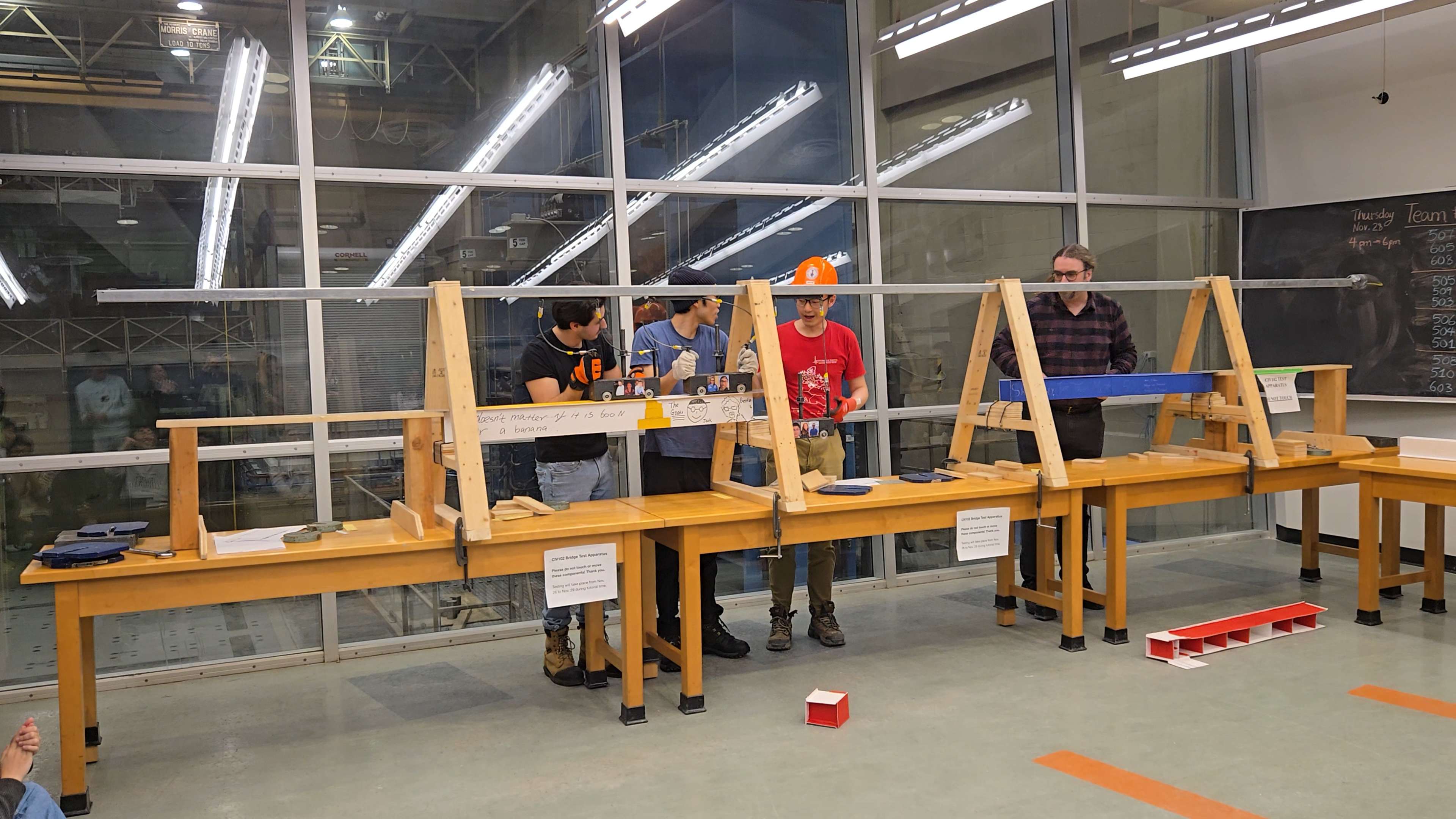
For the culminating project of CIV102 (Structures and Materials), our team was given a single 32×40 in piece of matboard and 60 mL of contact cement to build a 1200 mm bridge capable of supporting a 400 N dynamic train load and as much additional weight as possible until failure.
The challenge was to maximize strength-to-mass ratio through iterative design and structural analysis.
How It Works
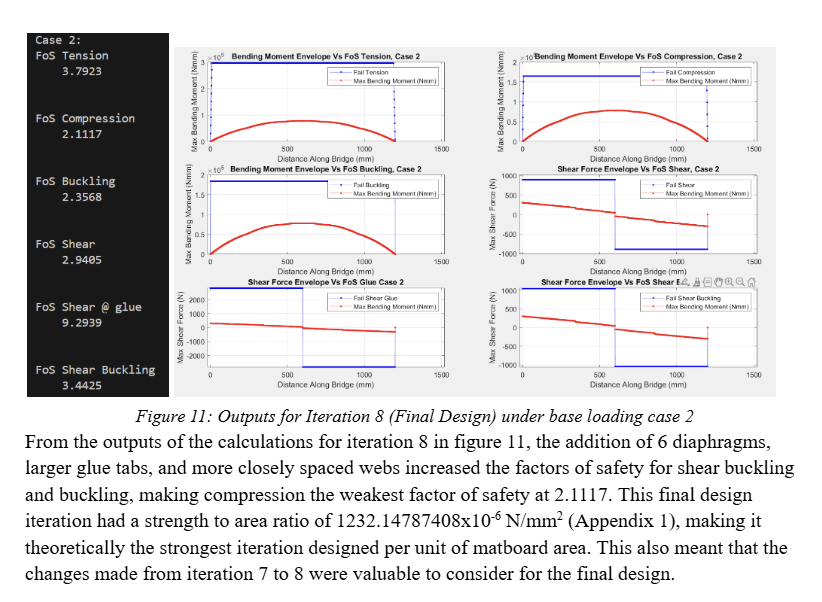
The design went through 8 iterations, using MATLAB and Python to calculate factor-of-safety (FOS) values across six failure modes: tension, compression, buckling, shear, glue shear, and shear buckling.
Key design decisions: double-layered top flange to resist compression buckling; no bottom flange (counterintuitively) because removing it improved strength-to-mass ratio; 117.5 mm web height to increase the second moment of area; 12 diaphragms (6 evenly spaced in the center, 6 clustered near supports to handle shear); offset splices staggered two-thirds of the span to prevent simultaneous joint failure; widened glue flaps for stronger adhesive bonding.
Design decisions were also shaped by consulting upper-year students who flagged torsion failure risks from overly tall decks and the importance of splice placement, insights the math alone wouldn't have surfaced.
Results
The bridge held 740 N before failure.
Bridge mass: 719.1 g. Strength-to-mass ratio: 104.9.
Placed 1st in our cohort and 3rd overall in the 2024 CIV102 Bridge Design Competition.