Traffic Jam Paper
Novel car-following model that reproduces phantom traffic jams.
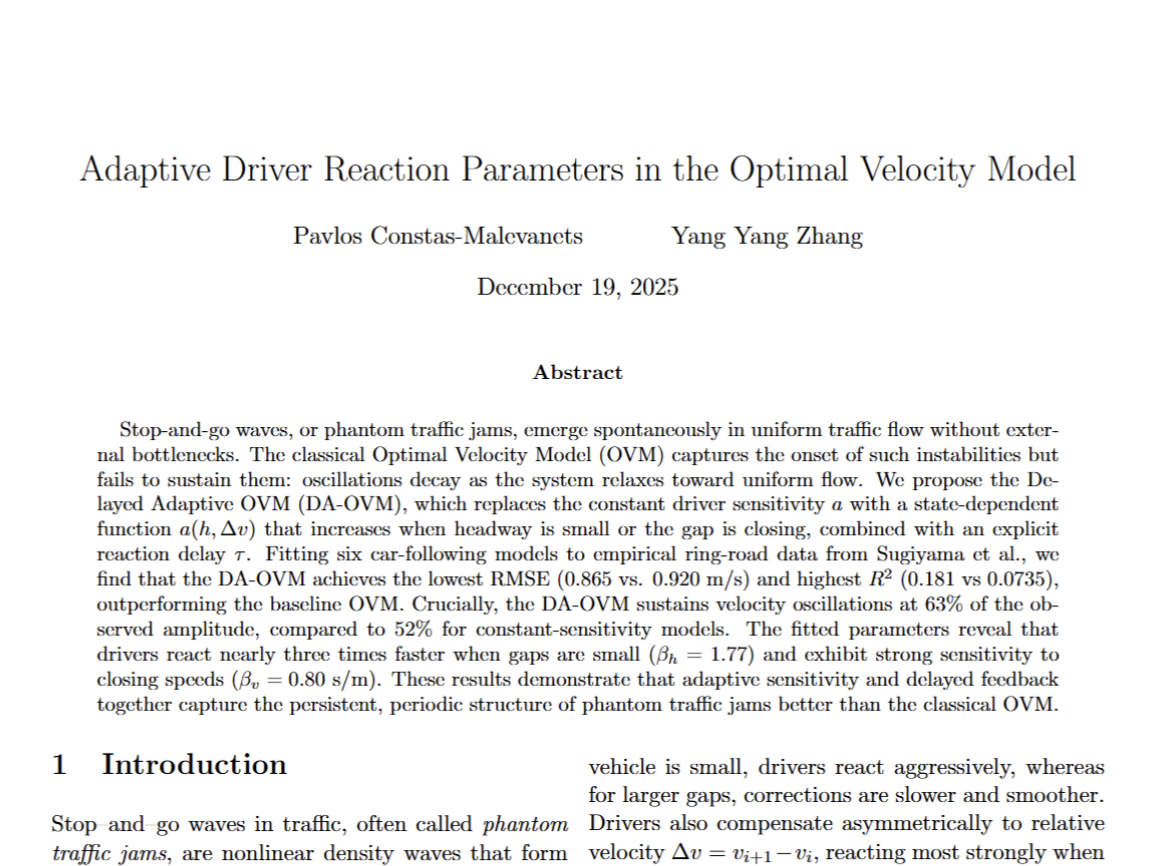
Description
For one of my courses, MAT292 Ordinary Differential Equations, I had to write a paper using an existing ODE to model a phenomenon and perform analysis with it. Me and my partner Pavlos decided to take this a step further, and propose a new model for the ODE we explored.
We were watching videos online for inspiration and stumbled upon an Instagram Reel that demonstrated how phantom traffic formed. We found this interesting and did a bit of digging to find that there was a widely cited ODE called the optimal velocity model (OVM) that modeled the creation of phantom traffic. We read papers and found a couple more variations of the OVM, but we found that none of them included any parameters to account for variable driver sensitivity. We added a state dependent function that increased when the headway was smaller, and combined it with a reaction delay. Our model modeled experimental data 21% better than the next best OVM.